
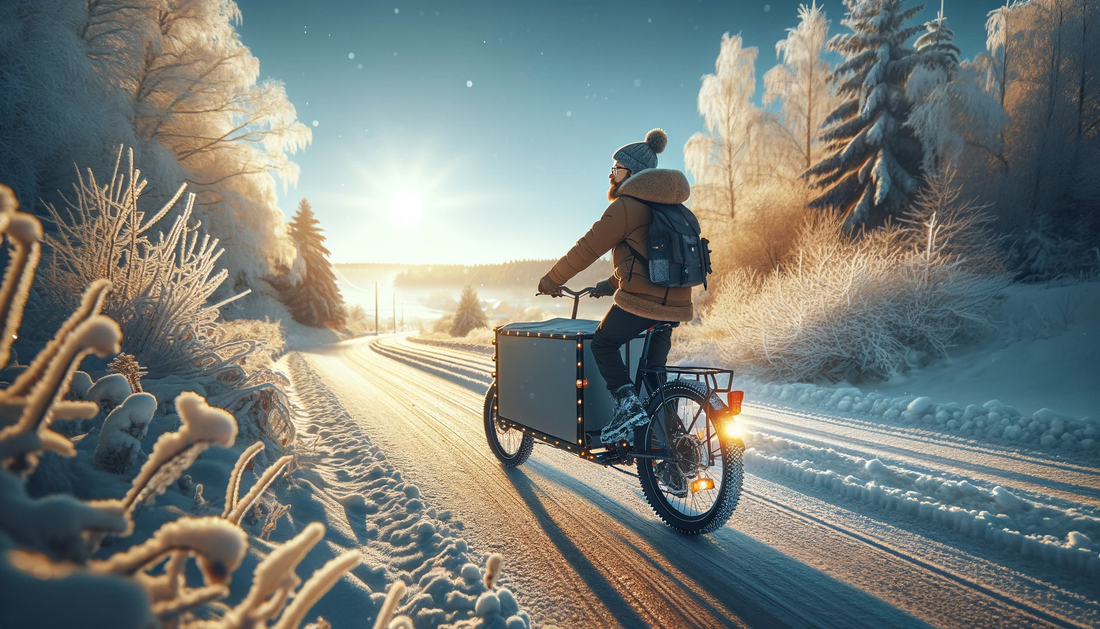
How to travel safely with your cargo bike in winter
shares
A cargo bike works excellently for everyday use, even in winter – provided you adapt to the cold, wet conditions, slippery roads, and early darkness. Especially when carrying children in the box, it is worth consciously checking a few points before the cold season begins.
Here you will find the most important tips regarding tires, brakes, batteries, children, wet conditions, cold, and visibility.
1. Tires and grip: Traction counts in winter
Wet road surfaces, fallen leaves, slush, or ice significantly change handling. Check the condition of your tires regularly and adjust your speed to the conditions. Depending on the region and usage, winter tires or studded tires can be beneficial.
Take corners more gently, brake earlier, and avoid abrupt steering movements. A loaded cargo bike reacts differently on slippery surfaces than a standard bicycle.
2. Check brakes more frequently
In winter, brakes are exposed to significantly more water, dirt, and salt. Therefore, regularly check brake pads, brake discs, and braking performance. Especially before trips with children, the bike should be able to slow down predictably and cleanly.
3. Protect battery and power bank from the cold
Cold can reduce the usable capacity of batteries and power banks. Charge them regularly and try not to store them in very low temperatures for long periods. This applies to both your e-bike battery and the power bank for your interior lighting.
4. Keep children warm in the cargo bike
Children hardly move during the ride and therefore get cold faster than the person cycling. Warm clothing, gloves, suitable blankets, and a well-closed rain cover make winter rides much more pleasant.
Also, always check straps, seating position, and the rain cover before setting off. Everything must still fit correctly, especially with thick winter clothing.
5. Wet and dirt: Maintenance pays off
Rain, slush, and road salt put more strain on components. Remove coarse dirt regularly and pay special attention to the chain, drivetrain, brakes, and moving parts. This keeps your cargo bike reliable even with daily winter use.
6. Significantly increase visibility in winter
In winter, you are frequently on the road at twilight or in the dark. Functioning front and rear lights as well as reflectors are therefore mandatory. Additionally, it helps to make the size and the box of your cargo bike more visible.
CargoGLOW illuminates the interior under the rain cover and simultaneously ensures that your cargo bike is much more clearly perceived from the outside. This gives you a better view of children and luggage while increasing your safety in the dark winter season.
You can find everything about lighting, visibility, and the right combination of front light, rear light, reflectors, and interior lighting in our detailed guide Cargo bike in the dark: Solving lighting and visibility correctly.
7. Adjust your riding style to winter conditions
More distance, lower speeds, and softer steering and braking movements help you maintain control even in difficult conditions. If a road is icy or poorly cleared, an alternative route may be the better choice.
8. Before every ride: quick winter check
- Check tires and air pressure
- Test braking performance
- Switch on front and rear lights
- Ensure the battery or power bank is sufficiently charged
- Close the rain cover correctly
- Buckle up children and bundle them up warmly
- Secure loose items in the box
Conclusion
Winter does not have to mean a break for your cargo bike. With good tires, functioning brakes, charged batteries, warm gear for the children, and good lighting, you can use your cargo bike safely and comfortably even in the cold season. CargoGLOW complements classic bicycle lighting where it doesn't reach: directly inside the box and under the rain cover.
![[de] CargoGLOW beleuchtet die Lastenradbox mit zwei Lichtstreifen unter dem Verdeck; Sitz und Gurte sind sichtbar. Endlich Licht in der Box: sehen, was du suchst.](http://cargoglow.de/cdn/shop/files/CargoGLOW-v2-01-de.png?v=1790715460&width=533)
![[de] UrbanHOOKS Hero](http://cargoglow.de/cdn/shop/files/C07136B5-39F0-40CA-8816-74AE672CCAF1.png?v=1777054186&width=533)
![[all] CargoGLOW](http://cargoglow.de/cdn/shop/files/image_b4008b8f-e0ce-4671-8739-8ccf9f19b9e0.jpg?v=1691697517&width=533)
![[all] UrbanHOOKS Inlay](http://cargoglow.de/cdn/shop/products/image.heic?v=1673707196&width=533)